Digital Cash, Not Crypto
Why a digital cash system matters – GNU Taler-Series #1

We have succumbed to a lie when it comes to the topic of digital payments. For years we had only the narrative that we have only a choice between giving up our privacy for massive credit card processors (like MasterCard or Visa) or dive into volatile energy-intensive and resource-hungry world of cryptocurrency (like Bitcoin or Ethereum).
But since 2025 (since 2016 as Proof of Concept) exists a third way that is mostly unknown and only somewhat used in Switzerland. This is a official GNU project and called GNU Taler (or simply Taler).
Unlike cryptocurrencies like those named above is Taler not a new currency but a payment protocol build on top of the traditional banking system. It doesn't use Blockchain technology, doesn't waste energy and solves one fundamental problem:
How do we make digital payments truly anonymous for buyers, while keeping them completely transparent for sellers?
The Core Concept behind GNU Taler
Asymmetric Privacy
Most privacy tools that exist today try to hide everyone. In recognising that payment systems need a different approach to survive in the real world and not being banned by governments for facilitating tax evasion, Taler split privacy right down the middle.
Customers are completely anonymous.
GNU Taler uses blind signatures (a cryptographic method that lets someone – in this case a bank – sign a digital coin without seeing the specific value or serial number). The shop you can buy from, banks and the infrastructure operators themselves have no idea who a customer is.
Merchants are completely visible.
Every transaction that a shop/merchant deposits is traceable. Businesses can't use it to hide income and making it completely compliant with taxation laws out of the box.
How it works
Instead of relying on distributed ledgers does GNU Taler introduce a few simple roles to handle transactions securely:
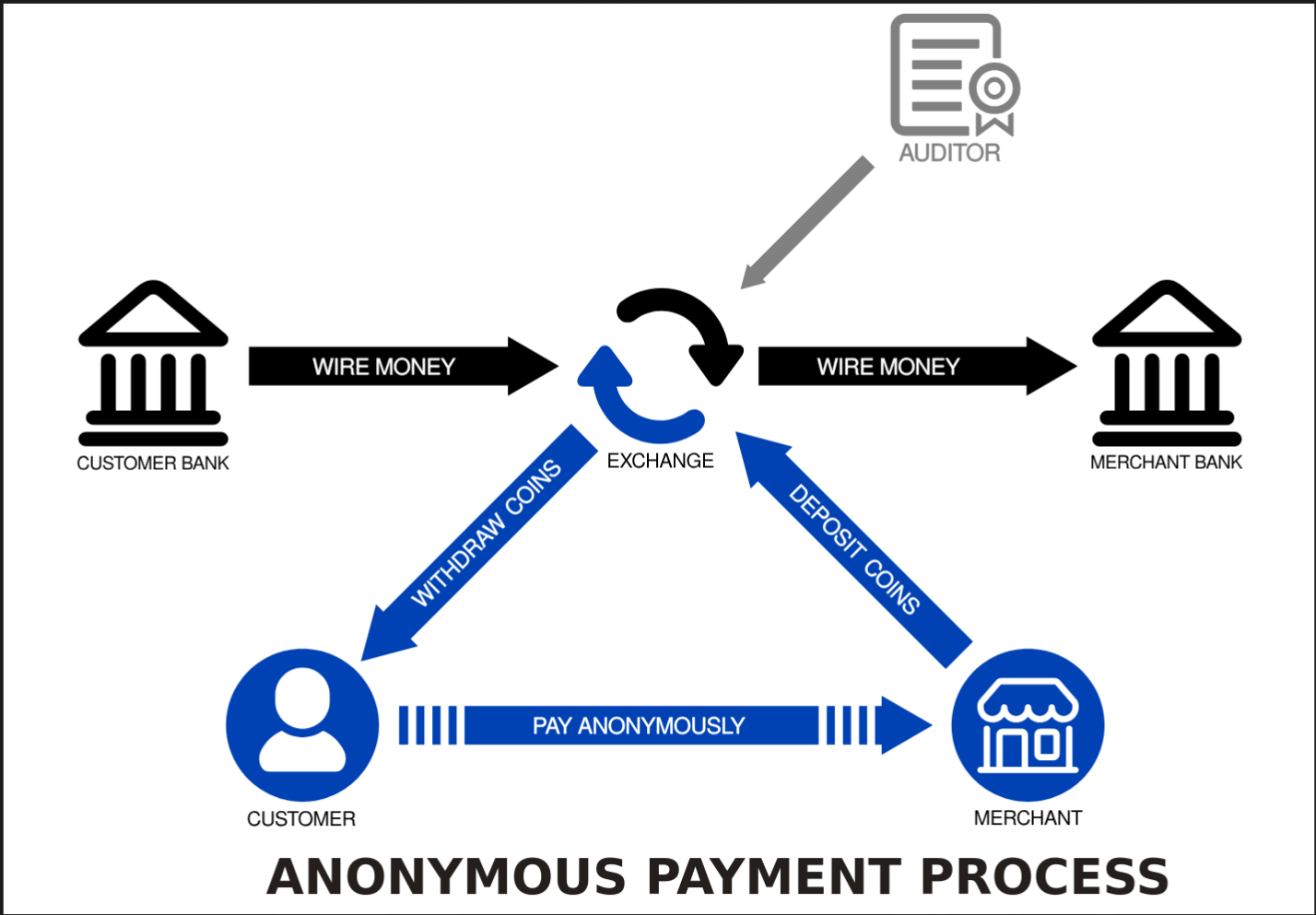
The magic of Taler happens in four core pieces:
- The Customer bank and Wallet: Someone (You or anyone else) use regular fiat currency (like Euros or Swiss Francs) to fund their local Taler wallet.
- The Exchange: The Exchange acts as the bridge as it takes your traditional money and issues signed digital coins to your wallet. And the exchange only knows it issued valid money but can't track specific coins back to the customer because of the blind signatures.
- The Merchant and Merchant bank: When clicking "Pay" does the customer's wallet directly send the digital coins to the merchant – which checks the signatures instantly and hands over or confirms the order.
- The Auditor: A critical independent body which checks that the cash reserves of the Exchange match the issued coins perfectly and that it doesn't print money out of thin air.
Why It beats traditional Crypto for Daily Use
If you have ever tried to pay for a coffee with cryptocurrency like Bitcoin then you know the pain. Waiting minutes for block confirmations, dealing with price swings and paying unpredictable gas fees.
Taler operates at the speed of all other web traffic. Transactions take milliseconds because they are just cryptographic signature verifications. Because a digital coin via Taler can be bound to a existing fiat currency (e.g. 1 Taler-€ = 1€) there is zero volatility risk. It acts exactly like the physical cash in your physical wallet – once you withdraw it, it's your business alone how you send it.
If you like this blog post you can support my work by either becoming a paid member or leaving a tip.
Local sovereignty
Digital regional currency without the Overhead
One of the most fascinating aspects of Taler is that it isn't locked to fiat currency like the Euro, Swiss Franc or US Dollar. An Exchange operator can define coins in any custom denomination and GNU Taler is arguably the most robust infrastructure ever build for regional or complementary currencies.
Regional currencies are designed to keep wealth within a specific community and encouraging people to buy from local shops instead of global retail giants. Historically these projects have relied upon paper vouchers that are a nightmare to maintain and audit.
With GNU Taler a municipality, local business association or a community network can spin up their own Exchange using FOSS (Free and Open Source Software) tools. Taler includes LibEuFin a project that provides free software tooling for FinTech as well the possibility to create and manage own digital regional currency. And as payments with Taler are fast, mobile-friendly and dead-simple they can compete with the convenience of Apple Pay, Google Pay and co, while guaranteeing that the money stays within the regional economy.
On a smaller scale (such as e.g. youth centers or street festivals) this exact tech stack can be used to run completely private and digital token or voucher systems which can run entirely without an connection to the outside world or an internet uplink.
Roadmap to Adoption
GNU Taler isn't just an academic paper or a proof of concept anymore as it's gaining some traction.
One of the biggest drivers is the NGI Taler initiative by the European Commission and the Swiss Government. Run in partnership with organizations like the NLnet Foundation, its explicit goal is to bring Taler to market across Europe as a production-ready, best-in-class electronic payment system.
Even in the discussion of establishing Central Bank Digital Currencies (CBDCs) – like an digital Euro – does GNU Taler stand out as an strong alternative and even national banks have come forward to state their support for GNU Taler and the Swiss National Bank (SNB) highlighted the technical feasibility in it's Working Paper 3/2021.
Taking back the Wallet
The real power of GNU Taler isn't just the cryptography but that it successfully challenges the Status Quo. Taler proves that digital convenience doesn't inherently require to give up privacy and submit to surveillance capitalism or speculative financial bubbles.
For privacy advocates and the open source community are protocols like Taler a missing piece to the answer to the digital sovereignty question. We already have reclaimed our communication with decentralised and/or open source tools, our hosting with independent infrastructure and our development environments with FOSS alternatives. It is only logical to think about doing the same thing to our financial transactions.
Whether GNU Taler is ultimately adopted as the blueprint for a digital Euro or simply spun up by communities to power (local) economies, it shows us what an ethical digital future can look like. It's cash, completely upgraded for the Internet age and the infrastructure is completely open to build upon.
Have you already tried GNU Taler or not? Let's talk about it! And come back when this series continues. 🪙
If you want to hear more from me, you can find me in the Fediverse at @gelbphoenix@social.gelbphoenix.de (Mastodon) or @gelbphoenix@gram.social (Pixelfed). For more posts like this subscribe to my newsletter or support me by becoming a member or donating.
Liked this post? Please share it with others via: Mastodon, Bluesky or anywhere else by copying the link.